

Augmented reality for business is a prime example of how quickly technologies go from cutting-edge experiments to a vital part of the modern world. Augmented reality (AR) overlays digital elements on top of the physical world to essentially meld them. Companies are using this technique to optimize workflow, enhance training, improve customer satisfaction, and innovate in countless ways.
In this article, you’ll discover how to leverage AR in your company to improve training, customer engagement, productivity, growth, and overall business strategy.
Table of Contents:
- What Is Augmented Reality for Business?
- Why Modern Businesses Are Investing in Augmented Reality
- Which Industries Are Successfully Implementing AR in Their Business Strategy?
- How to Choose the Best Augmented Reality Solutions for Your Business
- Key Use Cases and Benefits of AR for Businesses
- Measuring the ROI of Augmented Reality for Business
- Augmented Reality Industries; An Overview of All Sectors Using AR
- Benefits of Augmented Reality for Businesses; The Main Advantages
What Is Augmented Reality for Business?
Augmented reality for business involves strategically leveraging this immersive technology to enhance corporate productivity, spark engagement with customers, optimize general operations, and more. While AR is similar to virtual reality (VR), it differs in how virtual environments are experienced. VR fully removes people from the physical world and places them within a digital one. AR takes digital elements and projects them onto the user’s physical environment.
This level of integration means that it’s easy for AR users to access digital information and instructions while still working within the real world. AR is commonly used through phones and tablets, but glasses and headsets make this hands-free operation seamless. AR in business excels in anything related to data. Information-rich AR workflows can move faster while also reducing errors.
Why Modern Businesses Are Investing in Augmented Reality
One of the strongest motivators for a company interested in augmented reality for business is the simple fact that it has demonstrated consistent value. Some of the strongest leaders in healthcare, retail, manufacturing, logistics, and more have already incorporated AR to achieve tremendous results.
AR can work on common devices like smartphones while also ensuring that employees know the basics of the hardware. AR reduces costs while growing potential revenue points. Companies have found that they can more easily address elements like skill gaps and employees who need to work remotely through strategically positioned AR. Businesses are discovering that areas they’ve struggled with in the past are easily addressed through AR.
Which Industries Are Successfully Implementing AR in Their Business Strategy?
While every industry can benefit from AR, a specially tailored approach is always ideal. The following examples highlight how specific industries are using augmented reality for business.
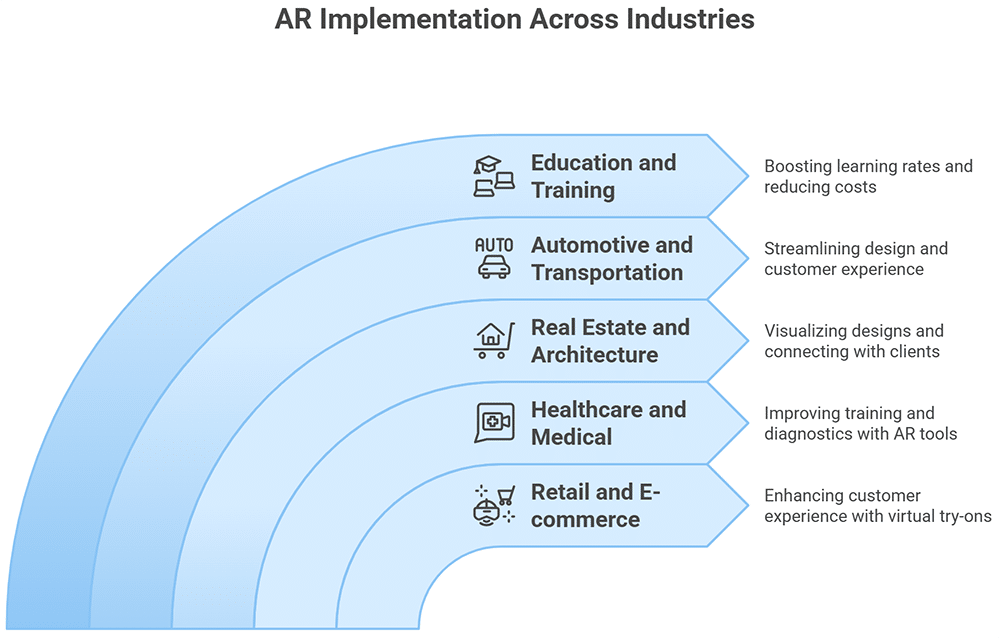
1. Retail and E-commerce
Retail is one of the most exciting areas to observe the potential of augmented reality applications for business. Brands like Warby Parker, IKEA, and Sephora are using AR to help customers make informed choices. This use of augmented reality for business leverages try-before-you-buy techniques to let customers try out products in advance through AR. People can see how furniture looks in their homes, how clothing works with their fashion sense, and more. This practice raises conversion rates, customer satisfaction, and brand engagement.
2. Healthcare and Medical
AR for training and development is one of the most popular forms of immersive technology. The medical sector, in particular, has leveraged it to great success. Medical students, surgeons, and other experts can hone their skills through practice without any risks. An AR system can also display a variety of health and diagnostic information as an overlay while medical professionals are at work. AR is also incredibly useful within medicine as a way of bringing in expert assistance within seconds to aid in procedures. AR improves results and the patient’s experience.
If you want to find more information about the role of AR in the healthcare industry, read “Augmented Reality in Healthcare: Clear Examples of AR in Healthcare.”
3. Real Estate and Architecture
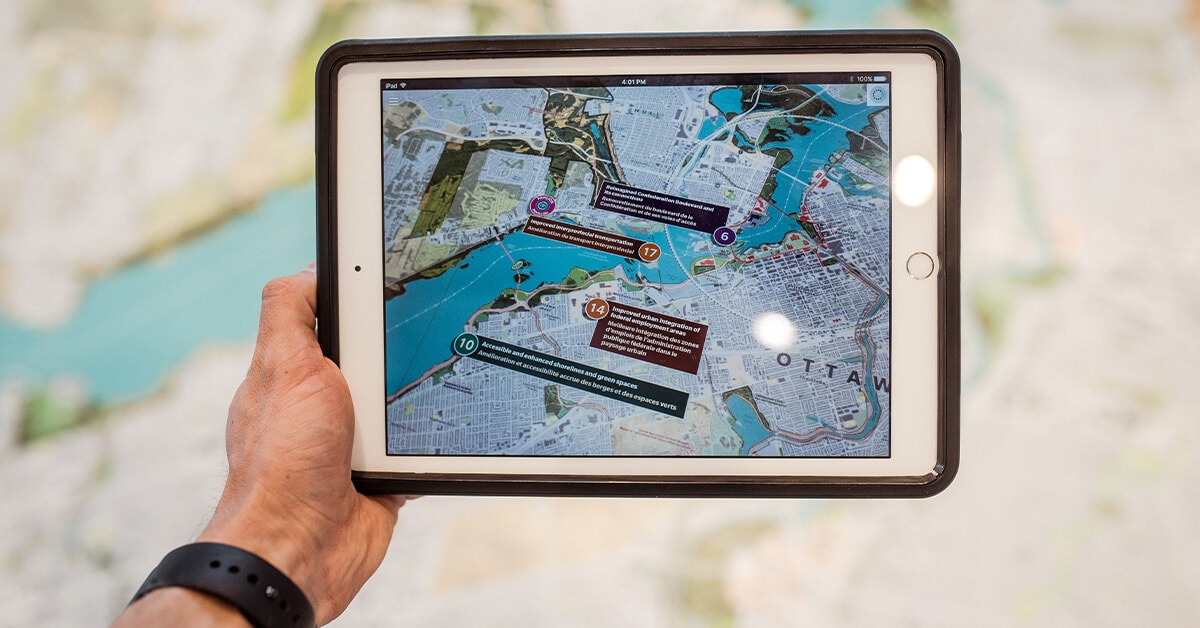
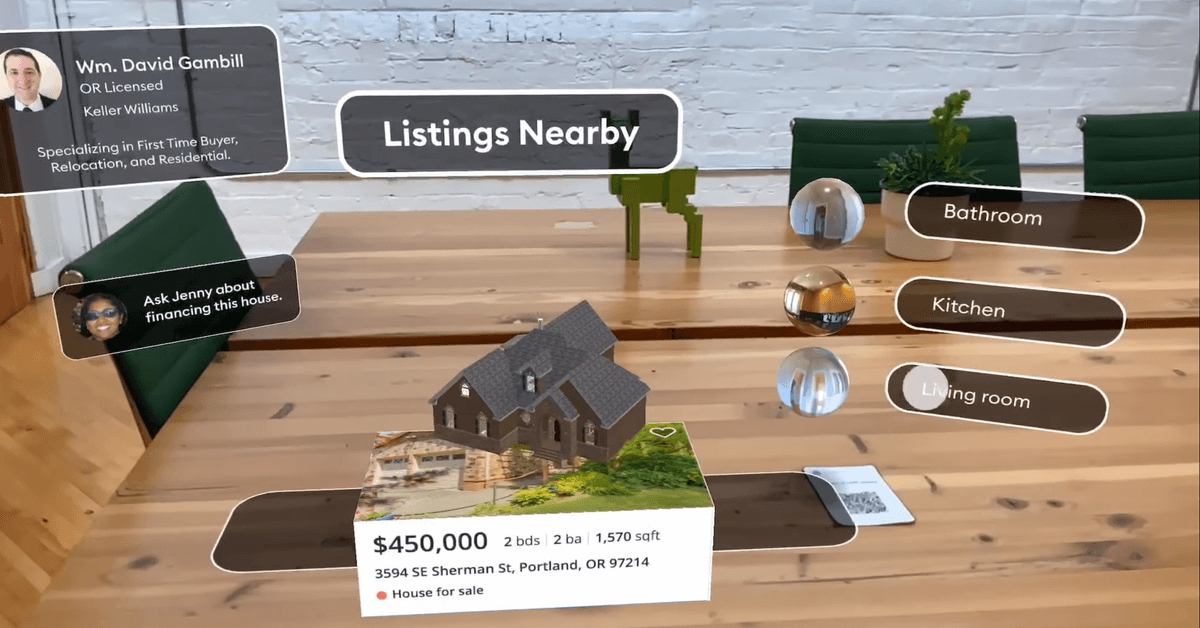
Business augmented reality strategies often involve finding new ways to connect with clients or customers. This is especially valuable for real estate and architecture, as visuals are vital within both fields. AR can be used to design buildings and instantly see potential flaws, for BIM data, and even aid collaboration. Likewise, AR is a valuable asset for potential buyers who want to see unfinished properties in their completed form.
4. Automotive and Transportation
Enterprise AR solutions often take a lengthy or expensive process and streamline it. This is evident in how the automotive industry is using AR for prototyping designs before costly production begins. AR is also an increasingly important part of both the customer’s experience and the maintenance process. Toyota, BMW, and Mercedes-Benz are only a few of the companies that use AR to help customers find their perfect car or drive it with AR-powered interfaces.
5. Education and Training
AR can be used to teach almost any subject. It’s being used in academia, medical education, engineering, and more. AR typically improves learning rates and retention while simultaneously lowering the overall cost of training. This is especially true for learning technical skills. Immersive technology is proving itself as a way to effectively add new employees in areas showing labor shortages through augmented reality for business. If you want to learn more about how AR is revolutionizing education, read “The Role of Augmented Reality in Modern Classrooms.”
How to Choose the Best Augmented Reality Solutions for Your Business
Considering the following elements will ensure you find the right augmented reality for business solution.
- Define Clear Business Objectives: Chart your technological needs by defining which elements AR will address – such as customer relations, training, or maintenance.
- Evaluate Industry Experience: Look at analogous implementations from associates and ask for business examples with relevant metrics.
- Examine Scalability: Consider elements like CMS, licensing, and hardware compatibility with your need to grow and scale deployment levels.
- Verify Integration Capabilities: Questions about compatibility with your current CRM, e-commerce, LMS, and ERP systems should be organized and presented to vendors to ensure proper deployment.
- Compare Content Creation Options: Determine potential timelines and operational costs by checking a vendor’s authoring tools or in-house options for development.
- Consider Total Cost of Ownership: Go beyond the starting price by considering additional costs such as software licenses, additional hardware, training programs, content creation, support, and more to determine the total cost.
Key Use Cases and Benefits of AR for Businesses
While augmented reality for business has an almost limitless number of uses, the following scenarios highlight the most valuable.
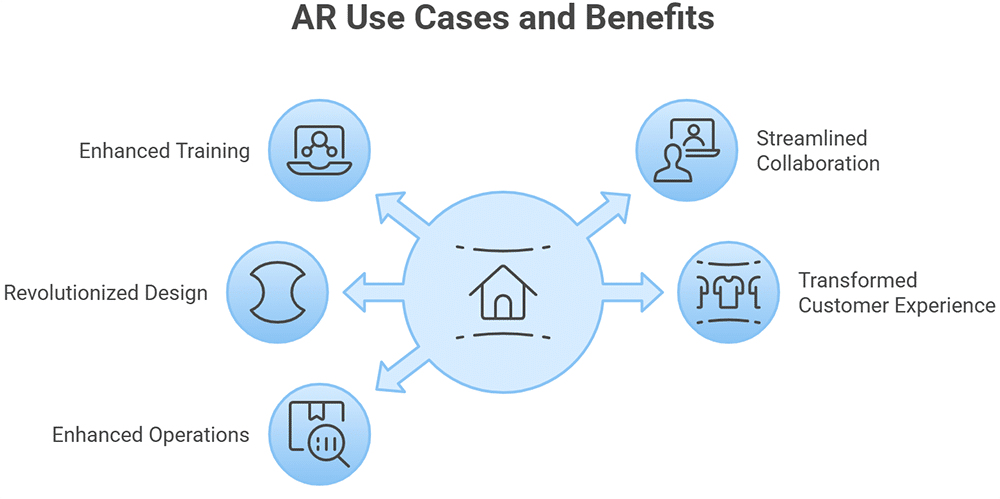
1. Enhanced Employee Training and Development
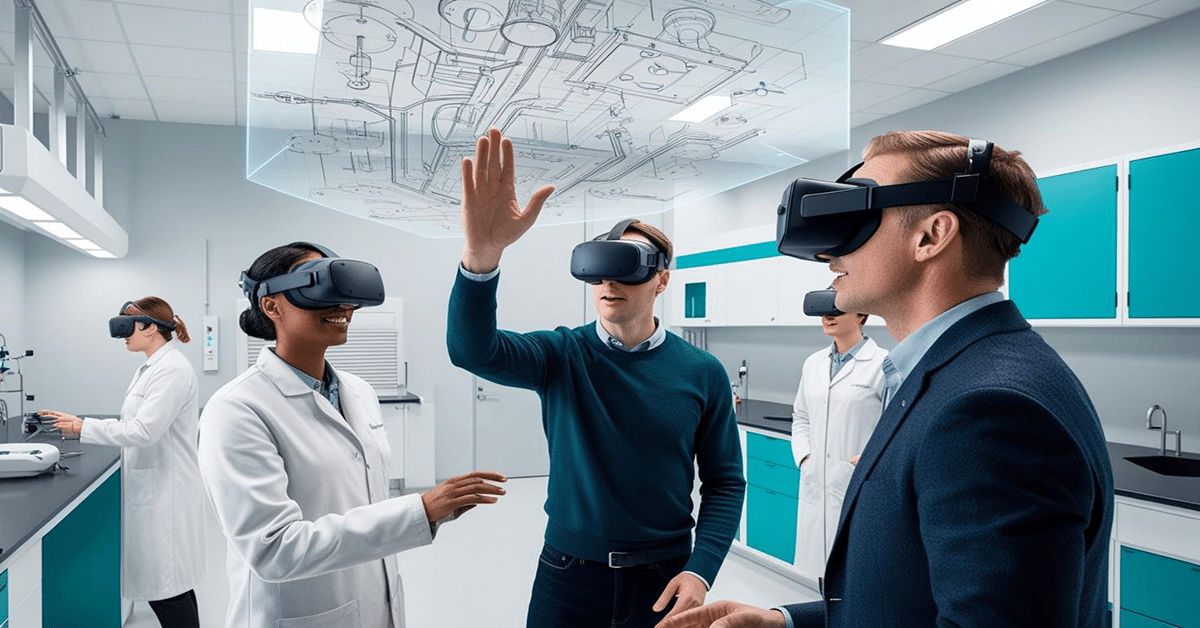
AR for business growth often starts with employee training. AR lets people practice, with full instructions, with no real risk. This has shown up to a 60% reduction in training time while also improving retention of the material. AR also ensures standardized educational experiences in all locations.
2. Streamlined Remote Collaboration and Maintenance
Costs associated with distance can often be removed through AR. Experts working remotely can guide a local technician with visual overlays rather than just words alone. Many companies have used AR to reduce equipment downtime by 25% to 40% while lowering travel-related expenses.
3. Revolutionized Product Design and Prototyping
Design teams can use AR to create prototypes without the expense of physical production. Creating a virtual prototype can reduce costs by up to 30% while also improving the overall development time. This type of AR-based design allows for collaborative visualization among both team members and stakeholders.
4. Transformed Customer Experience and Engagement
Customer satisfaction and engagement go up when they can try items before they buy. AR lets customers do exactly that, but without the need for physical merchandise. Conversion rates can go up by 30% to 40% when people try a product out through immersive technologies. Meanwhile, the chance of the customer returning the product goes down while still providing marketing data.
5. Enhanced Operations and Decision Making
The ability to turn data into interactive 3D displays is incredibly useful for warehouse processing and distribution. Likewise, executives are leveraging this ability to collaboratively discuss analytics in a more intuitive way. It’s often far easier for a team to notice trends when the data is responsive and can be examined by the full team from multiple angles.
Measuring the ROI of Augmented Reality for Business
Successfully creating and implementing augmented reality for business strategies requires careful attention to the following metrics.
- Training Efficiency: You can expect training time reductions of 30% to 60% when AR is used for onboarding and employee education.
- Maintenance Performance: Technicians using AR can dramatically improve their service and first-time fix rates during repairs while also impressing customers.
- Equipment Uptime: Equipment downtime metrics typically show a reduction of 25% to 40% thanks to AR-related maintenance.
- Retail Conversion: Sales conversions are typically boosted by 25% to 40% when products are displayed through AR.
- Travel Cost Reduction: AR reduces requirements for travel when remote, expert assistance is needed, thanks to AR-powered collaboration.
- Implementation Timeline: You’ll typically see results from AR pilot programs at 3 to 6 months and 18 to 24 months for positive ROI on a full enterprise rollout.
Augmented Reality Industries; An Overview of All Sectors Using AR
Augmented reality for business use provides a number of unique opportunities to specific sectors. Some AR benefits are universal. However, the best augmented reality solutions for business come about through careful implementation according to a company’s own requirements. You can discover how a variety of business sectors have adapted VR to their needs in the article “Augmented Reality Industries; An Overview of All Sectors Using AR.”
Benefits of Augmented Reality for Businesses; The Main Advantages
Augmented reality for business has already shown itself to be immensely valuable to any company. However, there’s still more to learn about what AR can do for you. Enhanced customer experience with AR, specialized training procedures, boosting conversion rates, and more are subjects unto themselves. In the following article, you’ll discover how to make and optimize your investments in AR with “Benefits of Augmented Reality for Businesses; The Main Advantages.”
Augmented reality for business provides you with a powerful foundation for success. AR can optimize your business, improve customer satisfaction, and strengthen your brand. However, those benefits only start when you put together a plan. Consider what you’ve learned so far and meld it together into a solid strategy.
Did You Like This Article About AR Development Services?
You might also be interested in the following articles:
- How Augmented Reality Entertainment is Transforming Media
- Augmented Reality Markers Are Revolutionizing User Interactions
- Best AR Workshops to Boost Learning Through Immersive Tech


Leave A Comment