
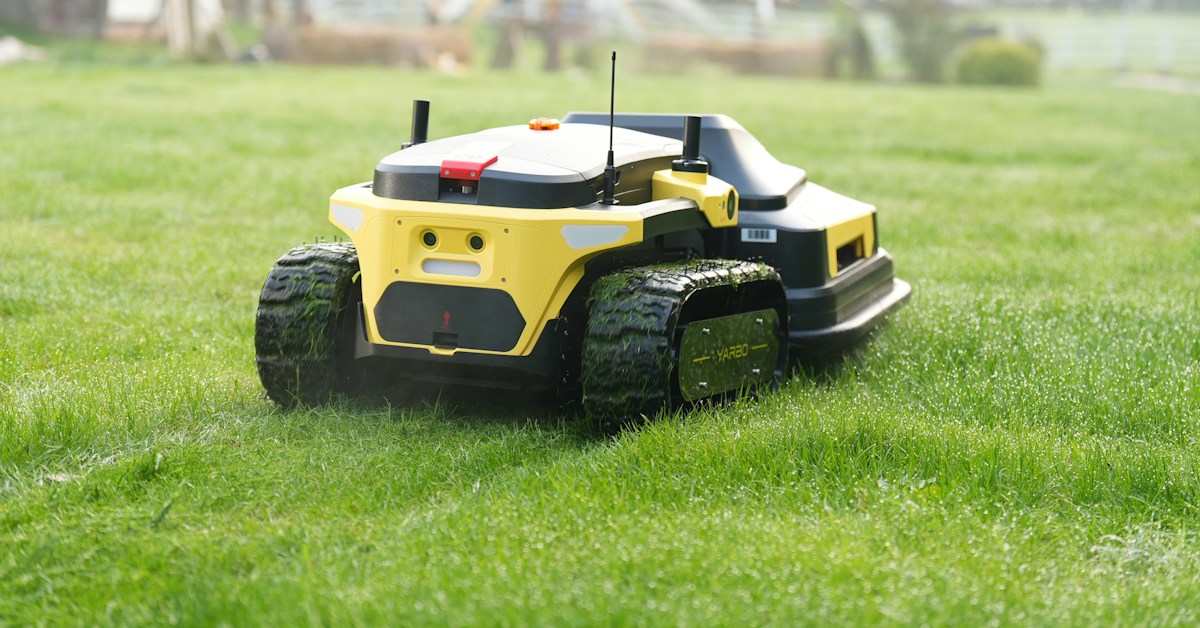
A robot lawn mower is a battery powered robot that cuts your grass on a schedule and drives itself back to its dock to recharge. Choosing one well matters because the model that aces a flat suburban rectangle can get hopelessly lost under your oak tree, and the spec sheet almost never warns you.
Key Takeaways
- Satellite RTK mowers need open sky, so dense tree canopy is where they most often lose their way.
- LiDAR mowers steer by fixed landmarks and get uneasy on wide, featureless lawns far from any structure.
- Camera only mowers like the eufy E18 skip setup hassle but depend on daylight and clear grass edges.
- Flagships such as Mammotion’s Luba 3 AWD fuse LiDAR, RTK and cameras so one sense covers another’s gap.
- A July 2026 FCC rule restricts new foreign produced robot mower models in the US, not existing ones.
Why Is a Robot Lawn Mower Really a Navigation Problem?
Cutting grass is the easy bit. A spinning disc with a few razor blades solved it years ago, and every mower on this list does it competently.
The hard part is the question the robot asks itself all day long: where exactly am I, and where does the lawn stop? For two decades the answer was a buried perimeter wire carrying a faint signal, the same trick as an invisible dog fence. Wire free models replaced it with three senses, and each one leans on something your garden either has or lacks.
Satellite mowers use RTK (satellite positioning corrected down to centimeters), and they need open sky. Husqvarna says its EPOS reference station needs a clear 135 degree view of the sky in all upper directions, which tells you how seriously the industry takes overhead clutter. LiDAR mowers (laser scanners that measure the distance to everything around them) need fixed landmarks such as walls, fences and trunks, the same technique a robot vacuum cleaner uses to map your living room.
Camera mowers need daylight and a visible contrast between grass and everything that isn’t grass.
Here’s the twist nobody prints on the box.
These weaknesses are mirror images. The tree that blinds a satellite mower is the landmark a LiDAR mower steers by, while the wide open lawn that hands RTK a perfect sky gives a laser almost nothing to measure against.
So a robot lawn mower isn’t a mower with a computer bolted on. It’s a navigation system that happens to carry a blade, and you should buy it the way you’d buy hiking boots: for the terrain it will actually face.
The Sky, Landmarks and Light Test
We sort every wire free mower by the resource it depends on, then check that resource against your garden’s worst corner rather than its average square foot. Shopping on acreage and slope ratings alone is the classic mistake, because neither number tells you whether the robot will know where it is.
| Navigation type | What it needs | Where it struggles | Best fit garden | Example on our list |
|---|---|---|---|---|
| Boundary wire | A buried cable and a weekend with a spade | Any redesign means digging again | Heavily shaded lawns with a fixed layout | Husqvarna Automower 435 iQ AWD in wire mode |
| Satellite RTK | Open sky over the lawn | Dense canopy, tall walls, narrow side yards | Open lawns with a few scattered trees | Segway Navimow i2 AWD |
| LiDAR | Fixed landmarks within range | Huge featureless lawns, furniture that moves weekly | Built up yards boxed in by fences, sheds and trees | Ecovacs Goat A3000 LiDAR |
| Camera vision | Daylight and clear grass edges | Night, heavy shade, patchy grass | Small, well defined lawns | eufy E18 |
| Fusion | Two or three of the above | Price | Mixed gardens with trees, slopes and open stretches | Mammotion Luba 3 AWD |
The industry has already voted on wire. Consumer Reports evaluated nine robotic mowers for its 2026 ratings, and none of them required a perimeter wire.
The vote on everything else is still open, which is why the priciest models now carry two or three senses at once. Fusion isn’t a luxury feature. It’s the manufacturers admitting that no single sense works in every garden.
Best Robot Lawn Mowers and Which Types Handle Real Gardens
We’ve ordered these by how many real gardens each one suits, starting with the safest bet for a typical suburban yard. Each pick names its navigation type, so you can run it straight through the test above.
1. Segway Navimow i2 AWD
Navigation: Network RTK plus cameras. Best for: typical suburban yards with a few trees and some rough ground.
Segway’s Navimow line built its reputation on satellite mowing, and the i2 AWD is the version we’d hand to most first time owners. It uses Network RTK, so the satellite corrections arrive over a cellular connection instead of from an antenna you bolt to the shed, and Segway includes that data at no extra cost. Where coverage exists, setup feels closer to unboxing a robot vacuum than installing a sprinkler system.
The smart part is the backup. Segway pairs the satellite fix with camera positioning and says its upgraded triple frequency Network RTK delivers a 30% boost in accuracy while holding a stable signal in obstructed spots, under tall trees included. That’s Segway’s claim rather than our measurement, but the engineering instinct is right: a satellite mower with eyes degrades gracefully instead of stopping dead.
All wheel drive with chunky off road wheels handles roots, uneven stone paths and slopes up to 45%, according to Segway. At launch, Engadget reported prices of $1,000 for the i206 AWD and $1,300 for the quarter acre i210 AWD, which is reasonable money for a robot this forgiving.
The catch is geography. Check Segway’s coverage map before you buy, because without Network RTK you’re back to siting an antenna, and a garden under one continuous canopy will still test any satellite first design.
2. Mammotion Luba 3 AWD
Navigation: 360 degree LiDAR, RTK and dual cameras. Best for: big, steep, mixed gardens that have a bit of everything.
If your garden has a steep bank, a stand of mature trees and an open stretch out back, the Luba 3 AWD is the robot that refuses to choose. Mammotion’s Tri-Fusion system stacks all three senses, and the company’s own technical explainer is refreshingly candid about why. LiDAR leads near structures, RTK takes over in open areas where the laser runs short of reference points, and the cameras handle obstacles.
The drivetrain is the other headline. Mammotion rates the Luba 3 AWD for 80% slopes, nearly 39 degrees, which is steeper than most people would comfortably drag a push mower up. All four wheels drive, so damp banks that would spin a two wheel drive robot in place become routine.
That ambition costs money and some patience. The Luba 3 AWD sits firmly at the premium end of the market, and its app has more settings than a casual owner will ever touch.
Owners of a small, flat rectangle would be paying for capability their lawn never asks for. For a hillside garden with trees and open patches, though, this is the closest thing on sale to a mower that doesn’t care what your yard looks like.
Fusion is the reason. When one sense loses confidence, another is already holding the map, so the robot keeps cutting instead of parking itself in the middle of the lawn waiting for help.
3. Husqvarna Automower 435 iQ AWD
Navigation: EPOS satellite RTK, or a physical boundary wire. Best for: steep lots and owners who want a long term bet with US support.
Husqvarna was mowing with robots long before wire free was fashionable, and the 435 iQ AWD shows it. It navigates with EPOS satellite positioning, using either the reference station in the box or Husqvarna’s cloud corrections where they’re available, and a pivoting rear axle with all wheel drive keeps it planted on steep ground.
One detail sets it apart. Husqvarna lists both virtual and physical wire as boundary options, which makes this the only pick on our list that can fall back on a buried cable if your canopy defeats the satellites. In a heavily wooded lot, that old fashioned option is a feature, not a relic.
Husqvarna rates it for slopes up to 70% and sells it at a $4,999.99 list price. That’s roughly five times what Segway asked for the i206 AWD at launch.
What the money buys is a dealer network, a US support line and a maker that, as we explain below, was first to win FCC Conditional Approval for foreign manufactured robot mowers. For buyers worried about long term software support, that counts for something.
The weakness is the usual one for satellite first machines: dense tree cover. Husqvarna’s answer is the wire. Ours is to walk your garden first, look up from the worst corner, and decide which boundary mode you’ll need before the box arrives.
4. Ecovacs Goat A3000 LiDAR
Navigation: LiDAR plus an AI camera, no RTK. Best for: shaded, built up yards and anyone who wants to mow after dark.
This is the mower for the garden satellite robots hate. The Goat A3000 LiDAR skips RTK entirely and maps your yard from laser measurements and an AI camera, so there’s no antenna to place and no coverage map to check.
Ecovacs says the system delivers 2cm precise navigation even in complex layouts or at night, and that it works without interference from shadows or roofs. That’s the landmarks side of our test in action. A backyard boxed in by a house, a fence line and a couple of mature maples gives a laser plenty to measure against, and that’s exactly the garden that leaves satellite mowers hunting for a fix.
Ecovacs rates it for 50% slopes and 4 cm obstacles to climb over. It claims the robot recognizes more than 200 types of obstacles, hedgehogs included, which matters if your garden has wildlife or a dog with a habit of napping on the lawn.
Flip the garden and the logic flips too. A wide, featureless lawn stretching far from any structure is where LiDAR only designs get uneasy, and a yard whose furniture moves every weekend asks the map to keep up.
If your lawn looks more like a sports field than a backyard, a satellite or fusion mower is the better bet. If it looks like a walled courtyard with trees, this is the one we’d shortlist first.
5. Worx Landroid Vision Cloud
Navigation: AI camera vision plus Network RTK. Best for: half acre lawns with moderate slopes and buyers who want fusion on a budget.
Worx made its name in this space with the original Landroid Vision, a camera only robot that treated the grass itself as the boundary, with no wire, no antenna and no mapping. The Vision Cloud is what came next, and it’s telling. Worx added RTK Cloud corrections to the camera, which we read as a quiet admission that sight alone has limits on bigger lawns.
The result is a $1,199.99 half acre robot that combines AI vision with satellite precision, with RTK Cloud service included free for life and no antenna to install on site. Its Cut to Zero blade offset trims close to borders, so you spend less time finishing the edges with a string trimmer.
Who should skip it? Anyone with serious hills. Worx rates the Vision Cloud for 30% slopes, the gentlest rating among the larger lawn picks on this list.
For a moderately sloped, moderately treed half acre, though, it’s the best value way into fusion we’ve found. The camera handles the shady corner where RTK wobbles, and RTK handles the open stretch where the camera has little to go on.
There’s a small ecosystem bonus too. The Vision Cloud runs on the Worx PowerShare battery, so if your garage already holds Worx drills or trimmers, the battery isn’t a stranger.
6. eufy E18
Navigation: cameras only. Best for: small, sunny, well defined lawns and people who hate setup.
The eufy E18 is the purest camera mower here, and it’s the easiest one to live with if your lawn fits its world. There’s no wire, no RTK station and no satellite subscription, because the robot maps the yard with its cameras and plans its route from what it sees.
eufy rates the E18 for lawns up to 1,200 square meters, about 0.3 acres, and slopes up to 18 degrees. Initial configuration takes roughly five minutes, by eufy’s account, which is about as fast as robot mowing gets.
Camera navigation shines exactly where satellites struggle. Tall fences and a neighbor’s two story house don’t block anything a camera needs, as long as there’s daylight and a clear line between grass and everything else.
The flip side is light. Consumer Reports cautions that camera reliant mowers may not perform as well at night, and patchy grass or heavy shade blurs the very edge the robot relies on. Cutting height tops out at 3 inches, which matters if you keep a cool season lawn long through the summer.
Run it through our test and the verdict is simple. If your garden has light and clear edges, the E18 is the shortest route from box to cut lawn; if it has deep shade or bare patches, pick a LiDAR or fusion robot instead.
Does the FCC Rule Change Which Robot Lawn Mower You Can Buy?
For US buyers, yes, at the edges. On July 28, 2026 the FCC added foreign produced advanced robotic devices to its Covered List, which blocks new equipment authorizations regardless of where the maker is headquartered. It’s the same rule that sweeps up imported humanoid robots and robot dogs.
The FCC’s fact sheet says the restrictions apply to new device models. Retailers can keep selling models the FCC already authorized, and the mower already in your garden is unaffected.
The first exemption went to Sweden. Husqvarna announced that the FCC granted Conditional Approval on September 9, 2026 for four Automower platforms, which it expects to launch in the US in 2027, and said its already approved models on sale are exempt too.
This is where navigation choice matters even more than it did a year ago. If fewer new models reach US shelves, the robot you buy now has to fit your garden for several seasons, so matching its senses to your sky, landmarks and light is the decision you’ll live with longest.
Is a Robot Lawn Mower Worth It If Your Lawn Is Simple?
Here’s the strongest objection to everything above: on a flat, open, rectangular lawn, navigation type barely matters, and price, edge cutting and cut height should decide the purchase. That’s fair. On an easy lawn, almost any mower on this list will find its way, and the cheapest one that fits your acreage is a rational buy.
Expectations still need managing. “A robotic mower is for that person who’s looking to save themselves an hour or two a week,” says Chris Regan, who oversees lawn mower testing at Consumer Reports, adding that setup and a learning curve come with it.
Robots cut a narrow strip and work for hours, so they maintain grass rather than tame a meadow. They’re a subscription to tidiness, not a one time rescue.
Simple lawns don’t stay simple, either. A new shed, a growing tree or a trampoline changes how readable your garden is every season, which is why we’d still buy one sense more than today’s lawn strictly needs.
Jargon Translator
RTK: Short for real time kinematic positioning. Ordinary satellite location is accurate to a few meters, and RTK uses correction data from a fixed reference point to tighten that to centimeters, provided the robot can see the sky.
Network RTK: The same correction trick, delivered over the internet or cellular data instead of from an antenna in your garden. Setup gets far easier, but only if your provider covers your address.
LiDAR: Light detection and ranging. The robot fires laser pulses and times their return to build a 3D map of walls, trees and fences, much like a premium robot vacuum does indoors.
Sensor fusion: Combining two or more navigation methods so each one covers the others’ blind spots. It’s why flagship mowers cost more, and why they rarely end up stranded mid lawn.
FAQs About Robot Lawn Mowers
We’re genuinely excited by these robots, with one condition. The lawn you own matters less than the garden around it. Check your sky, your landmarks and your light, then buy the robot that can read what’s there, because a mower that knows where it is will always beat a bigger one that’s guessing.

Leave A Comment