
Verificar la información que te ha proporcionado una IA implica contrastarla con una fuente independiente y autorizada, no pedirle a la IA que te confirme su veracidad. Si le pides a un chatbot que te dé más información, obtendrás otra respuesta, no más pruebas. A continuación, te mostramos los 4 pasos, en orden, para comprobar si lo que te acaban de decir es cierto. El proceso funciona igual tanto si utilizas ChatGPT, Claude, Gemini, Perplexity o Copilot.
CONCLUSIONES CLAVE
- Pedirle a un chatbot que verifique su propia respuesta no se considera una verificación de hechos. Se trata del mismo sistema generando otra respuesta, no de una verificación independiente.
- Deloitte Australia acordó reembolsar parte de un contrato gubernamental de 1197 mil millones de dólares australianos en 2025 después de que un informe que elaboró contuviera citas académicas falsificadas y una cita judicial inventada.
- El informe del Índice de IA de Stanford de 2026 reveló que las tasas de alucinaciones en 26 modelos líderes oscilaron entre el 22 y el 94 por ciento en una prueba de referencia sobre la precisión de los datos.
- No todas las fuentes corroborativas son iguales: una fuente primaria, como un estudio original, una sentencia judicial o una resolución regulatoria, tiene más peso que una segunda página que repite la misma afirmación.
- Este proceso se aplica a cualquier asistente de IA, no solo a ChatGPT y Claude, sino también a Gemini, Perplexity y Copilot.
Cómo verificar la veracidad de lo que ChatGPT o Claude te dijeron en 4 pasos
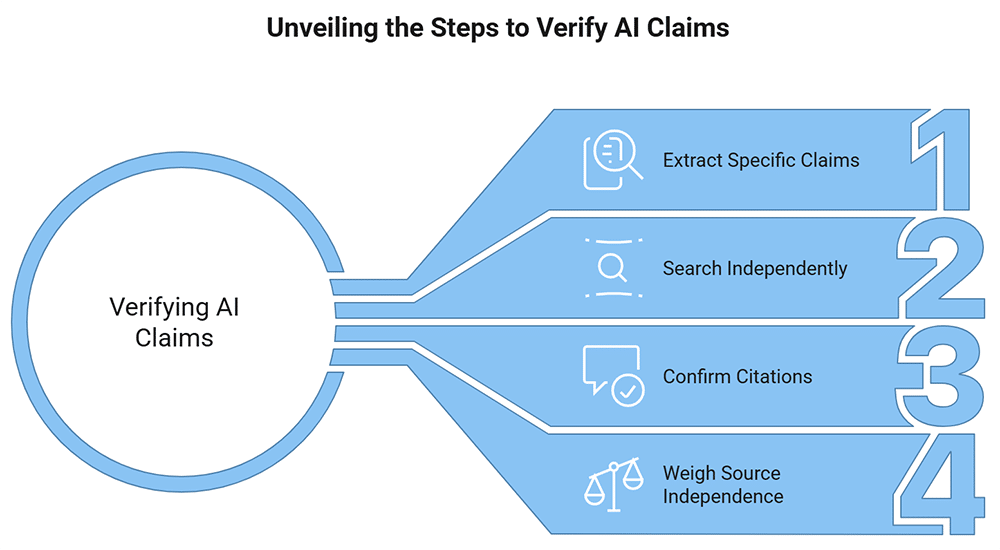
Aquí están los 4 pasos para verificar las afirmaciones de la IA, independientemente del asistente que estés utilizando, antes de actuar en consecuencia.
| Paso | Por qué funciona |
| 1. Extraiga cada afirmación específica: nombres, números, citas, referencias. | Vale la pena verificar los detalles específicos incluso cuando la respuesta general parezca correcta. |
| 2. Busque la estadística o cita exacta de forma independiente. | La ausencia de resultados es una señal de advertencia para seguir investigando, no una prueba de que la afirmación sea falsa. |
| 3. Haga clic en cualquier cita y confirme que dice lo que se afirmó. | Confirma que la fuente existe y realmente respalda la afirmación, no solo que se proporcionó un enlace. |
| 4. Analice su fuente: ¿es primaria o simplemente otra repetición? | Un estudio, una demanda o una sentencia original tienen más peso que una página que simplemente repite la afirmación. |
Paso 1: Extraer cada afirmación específica
Antes de hacer cualquier otra cosa, extraiga todos los nombres, fechas, estadísticas, citas y referencias de la respuesta de la IA.
Vale la pena verificar estos datos incluso cuando la respuesta general parezca correcta, ya que un modelo puede acertar en la idea general, pero equivocarse en un número, fecha o cita específica dentro del mismo párrafo. La especificidad no es sinónimo de precisión.
Preguntarle a un chatbot si está seguro es como preguntarle a un fundador si su plan de negocios funcionará. No te está mintiendo. Simplemente no está diseñado para distinguir entre confianza y certeza.
Paso 2: Busque la reclamación exacta de forma independiente.
Toma la estadística o cita específica que extrajiste y búscala fuera de la herramienta de IA, utilizando comillas alrededor del texto exacto.
Si no encuentra nada, es una señal de alerta, no una prueba de que la afirmación sea falsa. Los muros de pago, las paráfrasis del texto original, las lagunas en la indexación y la terminología ligeramente diferente pueden dificultar la localización de una afirmación auténtica en la primera búsqueda. Pruebe con fragmentos distintivos, frases alternativas, la institución mencionada y el título del informe en cuestión antes de concluir que la afirmación no es verídica.
No le preguntes a la IA de dónde sacó el número. Pregúntale a un motor de búsqueda y busca más de una vez antes de decidir.
Paso 3: Haga clic y lea la cita.
Si la IA proporcionó una cita, confirme que la fuente realmente existe y que dice lo que la IA afirma que dice.
Una cita que parece real, con un autor, revista y año plausibles, no es lo mismo que una cita verificada.
los Informe del Índice de IA de Stanford 2026 documentado Un estudio comparativo reveló que las tasas de alucinaciones en 26 modelos líderes oscilaron entre el 22 y el 94 por ciento. El informe también concluyó que los modelos manejan razonablemente bien las afirmaciones falsas atribuidas a otra persona, pero la precisión disminuye drásticamente cuando la misma afirmación falsa se presenta como algo que el propio usuario cree.
Las herramientas que incluyen citas en tiempo real agilizan este paso. Perplexity, ChatGPT con la función de búsqueda activada y la herramienta de búsqueda web de Claude enlazan las afirmaciones con fuentes específicas. Este enlace sirve como atajo para este paso, no lo sustituye.
Paso 4: Evalúe si su fuente es realmente independiente.
Encontrar una segunda página que repita la afirmación no es lo mismo que encontrar una confirmación independiente.
| Tipo de reclamación | Mejor fuente para verificar |
| Hallazgo de la investigación | El documento original o informe institucional |
| Ley o reglamento | Legislación oficial o el regulador directamente |
| Cita judicial | La sentencia publicada |
| Resultado de la empresa | Un documento reglamentario o el informe de la propia empresa. |
| Evento actual | Múltiples organizaciones de noticias de renombre |
El caso Deloitte es el ejemplo de advertencia más claro disponible, precisamente porque involucró a profesionales cuyo trabajo era la verificación. En 2025, Deloitte Australia acordó reembolsar parte de un contrato de informe por un valor aproximado de 1197 440 000 AUD al Departamento de Empleo y Relaciones Laborales del país, después de que Investigador de la Universidad de Sídney Se descubrió que el informe contenía citas académicas falsificadas y una cita falsa de un tribunal federal.
El informe revisado reveló que se habían utilizado las fuentes Azure y OpenAI en su elaboración; Deloitte confirmó los errores de citación sin afirmar que todas las imprecisiones fueron generadas por IA.
Una de las mayores empresas de servicios profesionales del mundo entregó un informe al gobierno con citas a académicos y casos judiciales que nunca existieron, y nadie que lo revisó antes de su publicación pudo rastrear su origen hasta la fuente primaria.
¿Por qué pedirle a la IA que se revise a sí misma no cuenta como un paso?
Porque la segunda respuesta proviene del mismo sistema que produjo la primera, utilizando el mismo entrenamiento y la misma tendencia a generar textos que suenan plausibles.
Cuando le preguntas a un modelo de lenguaje “"está seguro,"” No consulta una base de datos de hechos verificados. Genera una nueva respuesta con los mismos patrones que produjeron la respuesta original. Volver a preguntar puede reproducir, corregir o reforzar con seguridad el error original, porque la nueva respuesta no constituye evidencia independiente de nada.
Hacerle la misma pregunta a un segundo modelo de IA sirve como verificación complementaria, no como sustituto de los cuatro pasos anteriores. Si ChatGPT, Claude y Gemini dan respuestas significativamente diferentes, es probable que al menos uno esté equivocado. Si coinciden, esto aumenta ligeramente la confianza, pero no demuestra nada por sí solo, ya que los modelos pueden compartir datos de entrenamiento y repetir los mismos errores.
¿Cuánto de esto realmente necesitas hacer cada vez?
Adapta tus esfuerzos a lo que está en juego, no a los cuatro pasos como si fueran una lista de verificación rígida para todo.
Para usos de bajo riesgo, como redactar un correo electrónico, generar ideas o explicar un concepto que uno mismo puede verificar, una verificación superficial es suficiente. Sin embargo, para reclamaciones médicas, legales, financieras o de seguridad crítica, la verificación con un profesional cualificado o una fuente oficial autorizada es indispensable, y ninguna búsqueda independiente en internet la sustituye.
En este caso, los trabajadores autónomos y los profesionales independientes están expuestos al mismo riesgo que las grandes empresas: una sola estadística falsa en un informe para un cliente daña la credibilidad independientemente del tamaño de la empresa.
Indicador débil vs. indicador fuerte
| Mensaje débil | Indicación fuerte |
| “¿Estás seguro de que eso es correcto?” | “Enumera cada estadística, cita y referencia específica de tu última respuesta, sin añadir nada más.” |
Preguntas frecuentes
Verificar la veracidad de una IA no es una conversación con ella. Es una investigación que se realiza en otro lugar, evaluando si la fuente es realmente independiente y no simplemente una copia. El caso de Deloitte le costó a una consultora global una gran credibilidad por saltarse precisamente ese paso. Trate cada afirmación como no verificada hasta que una fuente primaria la confirme.






Leave A Comment