
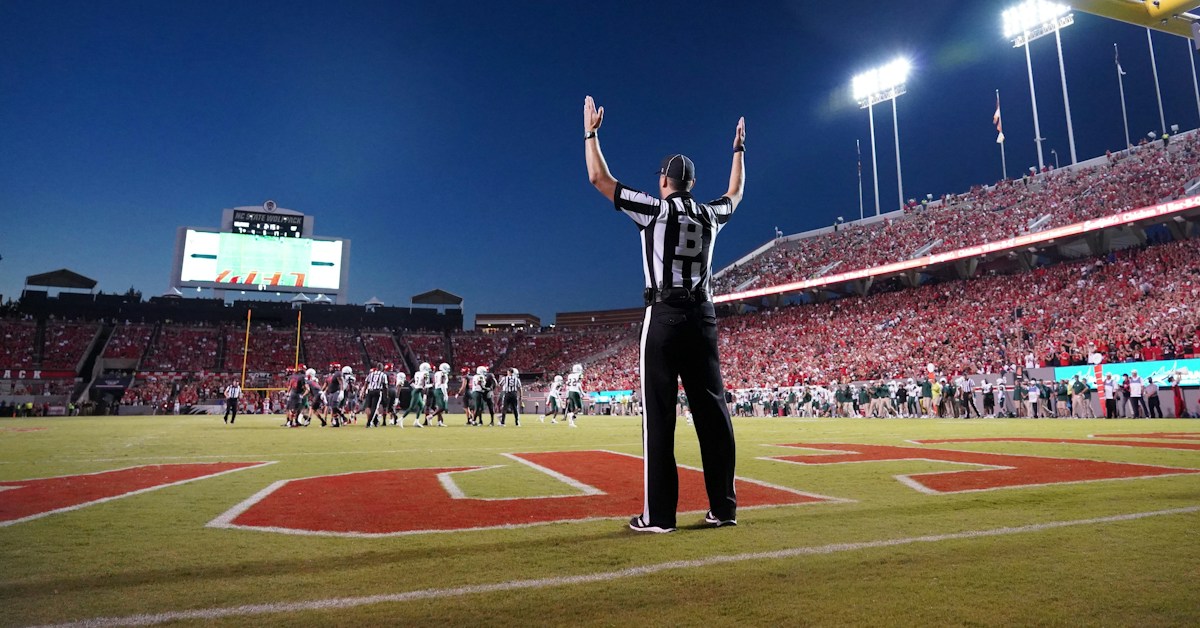
Augmented reality in the NFL is the layer of graphics broadcasters pin onto the real field, from the yellow first down line to glowing circles under likely blitzers. It matters because those marks now carry two very different kinds of information, measured facts and machine forecasts, and they look exactly alike on your TV.
Conclusiones clave
- ESPN’s 1998 yellow line won fans over because it bent with lens distortion and hid beneath players’ feet.
- Every NFL broadcast graphic falls into fact, forecast or fun, and each deserves its own level of trust.
- Amazon’s Defensive Alerts predict likely blitzers before the snap, putting machine guesses onto the main broadcast feed.
- The NFL barred the broadcast line from replays so viewers couldn’t use it to second guess referees.
- Hawk-Eye cameras now handle official first down measurements, but human officials still decide where the ball sits.
How Augmented Reality Is Changing NFL Broadcasts
Football TV got its first true AR hit on September 27, 1998, when a yellow line appeared across the turf during ESPN’s Bengals and Ravens telecast. Fans had spent decades squinting at orange sideline markers. Overnight, the most important distance in football became something you could simply see.
That line set the template for everything since. It drew something that existed in the rulebook but not on the grass, and it drew it so convincingly that plenty of fans now expect to see it in the stadium too.
Here’s the shift most coverage misses. For two decades, broadcast AR mostly showed you where things were, and now it increasingly shows you what’s about to happen.
Same paint, different promise.
Those two jobs deserve very different levels of trust, yet they arrive on your screen looking identical. If you watch football with any curiosity about strategy, learning to tell them apart is now part of reading the game.
How Does the Yellow First Down Line Actually Work?
The trick is that the line never really sits on your screen. It sits on a digital model of the field, and each broadcast camera reports exactly where it’s pointing so a computer can redraw the line from that angle, frame after frame.
Sportvision’s engineers surveyed each field’s crown with lasers, fitted cameras with sensors to read pan, tilt and zoom, and corrected for lenses that, according to the IEEE engineering history, swing from 10 percent pincushion to 10 percent barrel distortion as they zoom. A perfectly straight yellow line would have looked fake beside the slightly curved white ones. So they bent it to match.
Then came keying (deciding, pixel by pixel, what’s grass and what isn’t). The line only paints over turf colored pixels, which is why a running back’s cleat seems to land on top of it instead of vanishing behind it.
The most successful graphic in sports television succeeded by pretending not to be a graphic.
Today’s systems do the same job with sharper tools: optical tracking (cameras locating objects by sight rather than by sensors) for SkyCam, Lidar scans of whole stadiums, and Unreal Engine rendering. The principle hasn’t budged in nearly three decades. AR in a broadcast is a 3D model of the venue married to a camera that knows where it’s looking, and every mark you see on an NFL field depends on that marriage holding.
The Three Inks of Augmented Reality in the NFL
We sort every mark painted on an NFL broadcast into three inks. Fact ink draws something measured or defined by the rules, forecast ink draws something a model thinks is likely, and fun ink draws something nobody pretends is real.
| Ink | What it draws | Where it comes from | NFL example | How to read it |
|---|---|---|---|---|
| Fact ink | Measured positions and rule lines | Calibrated cameras, the spotted ball, stadium sensors | First down line, live wind arrows | Trust it as far as its input |
| Forecast ink | Probable behavior | Machine learning models running on player tracking data | Defensive Alerts blitz circles | A smart guess, never a call |
| Fun ink | Invented objects and characters | Animation engines and 3D stadium scans | Nickelodeon’s slimed end zones | Enjoy the show |
Fun ink is the easiest to spot and the least risky, since no viewer mistakes a cartoon slime cannon for officiating. Even here, the people behind it insist the graphics carry the story. Jason Cohen, senior vice president of remote technical operations at CBS Sports, said of the Nickelodeon telecasts that AR “isn’t just there for eye candy.”
The real trouble lives in the gap between the first two inks. Both arrive as clean shapes pinned to the turf, both move with the camera, and both borrow the authority the yellow line spent decades earning.
Why Do Prediction Graphics Change the Deal With Viewers?
That gap mattered less when nearly every mark was a measurement. It matters now because tracking data has made prediction cheap enough to paint live.
Amazon calls Defensive Alerts the first predictive behavior AI model used inside a live NFL broadcast. Before the snap, it watches how defenders move and drops a red circle under the players it expects to rush the quarterback, and Amazon says the feature now runs on the main Thursday Night Football feed, not only on the Prime Vision alternate stream.
It’s clever, and we like it. Watching a circle bloom under a creeping safety teaches you to read pressure the way a quarterback does.
But a red circle under a linebacker is a forecast wearing the uniform of a fact. The yellow line can only be wrong about the spot it was fed, while a blitz circle can be wrong about the entire next four seconds.
The fairest pushback is that viewers aren’t fools, and Amazon brands these as AI insights rather than rulings. That’s true, and incubating features on an opt in stream first is responsible design. Our point is narrower: the visual language hasn’t caught up, so fact ink and forecast ink still share one grammar on the grass.
Is the Yellow Line Official, and Does the NFL Use AR Itself?
No, and the backstory is delicious. When the NFL approved the line, the IEEE history records, league officials insisted it never appear during replays so nobody could use it to second guess referees.
For 27 years, the most trusted line in football had no official standing at all.
Then the league started drawing its own fact ink. Beginning with the 2025 season, the NFL made Sony’s Hawk-Eye system its primary line to gain method, with six 8K cameras per stadium producing virtual recreations for fans in the building and at home in around 30 seconds. The chain gang now waits on the sideline as backup.
Hawk-Eye has limits worth spelling out. Officials still spot the ball by eye, and the cameras only judge whether that spot reaches the line to gain, which is the clearest proof yet that fact ink is only as good as its input.
For you as a viewer, the practical upshot is simple. The yellow stripe on your TV is the network’s helpful sketch, the league’s measurement is the ruling, and when the two seem to disagree, the ruling wins every time.
Where Is NFL Broadcast AR Heading Next?
At Super Bowl LX in February 2026, NBC and SMT debuted an AR wind visualization that turned live readings from stadium wind sensors into arrows floating over the field, built to explain kicking decisions. That’s fact ink at its best: invisible, measured and decisive. Fox Sports is heading the same way this season, folding more Next Gen Stats into live graphics and rebuilding plays with limb tracking from Skyhook.
The direction of travel is clear, even if the destination isn’t. Broadcasts are stacking more forecast ink on top of richer fact ink, fed by tracking tags in every player’s shoulder pads, and the same tracking first logic is reshaping baloncesto de realidad aumentada and the wider world of deportes de realidad aumentada.
Expect the arguments around these graphics to shift with them, from whether they look real to whether they’re right. The screen, meanwhile, still offers no labels on the turf. So the next time a shape appears on the field, ask one question: was this measured, modeled or made up?
Traductor de jerga
Keying: The process of deciding, pixel by pixel, which parts of the picture are grass and which aren’t, so the yellow line slides politely under players instead of painting over them.
Seguimiento óptico: Using cameras and software to work out where something is, a football or a SkyCam, by watching it rather than strapping a sensor to it. Hawk-Eye works this way.
Alternate stream: A second version of the same game built for a narrower crowd, like Prime Vision for strategy nerds or Nickelodeon’s slime telecast for kids. Same plays, very different paint.
FAQs About Augmented Reality in the NFL
We love this stuff, and we want more of it. The yellow line earned its trust by drawing only what was true, and the new graphics are spending that trust on guesses. The fix isn’t fewer forecasts. It’s giving measured, modeled and made up three different looks on the grass.



Leave A Comment